From Gallery Walls to Virtual Worlds: My Path to VR Storytelling and Coaching
 USC IGM Virtual Art Gallery in an immersive environment. Source: Your Digital Storytelling Project, “Mental Health Storytelling Using Virtual Reality.”
I have long been interested in what happens when a physical gallery becomes part of an immersive digital environment. The central question for me is not whether virtual reality replaces an art gallery. It is how technology changes the conditions under which artwork, personal stories, educational discussion, and community participation can meet.
My work with the USC IGM Art Gallery became part of a longer professional journey connecting media psychology, digital storytelling, immersive environments, and what I now call VR Storytelling and Coaching. That journey moves from a socially engaged physical gallery, through conversations about media and trauma, into the USC IGM Virtual Art Gallery in FrameVR. I want to use this piece to show how those connections developed and why they still matter to my current professional focus.
The physical USC IGM Art Gallery
The USC IGM Art Gallery and the Art of Building Community
The physical USC IGM Art Gallery was more than a conventional exhibition space. Under the direction of Lynn Crandall, it brought together art, health, public dialogue, technology, social responsibility, and community relationships in one shared space.
The gallery’s public profile was recognized in a White House volunteer-service context. As documented by the USC Keck source, an award and a letter signed by President Barack Obama were presented to Crandall by Jennifer Morgan, president of the United Nations Association, Beverly Hills.
The recognition addressed the gallery’s mission and its network of public, private, nonprofit, faith-based, academic, and media partners. The stated emphasis was on developing economic self-sufficiency and social justice on both USC campuses and in surrounding communities.
That context matters to me because it places the gallery within a civic and collaborative tradition. It was not simply a room where objects were displayed. It was also a setting in which art could become a starting point for conversations about institutions, community life, technology, and human possibility.
A Gallery Built Around Relationships
The gallery operated within the Keck School of Medicine environment while reaching beyond a conventional medical or exhibition setting. As the Keck source makes clear, it connected public, private, nonprofit, faith-based, academic, and media communities in ways that made reflection, exchange, and collaboration central to its value.
That matters because the gallery’s importance was not that it turned art into psychotherapy or replaced medical or psychological treatment. Its importance was that it created a place where people from different backgrounds could encounter ideas together, test assumptions, and think more broadly about what art, health, education, and public life might mean in relation to one another.
Lynn Crandall on Better Health Through Art
In “Better Health Through Art: An Interview with Lynn Crandall”, Crandall’s work is presented through a broad view of health shaped by environments, relationships, expression, learning, participation, meaning, belonging, and imagination. I take that as part of the larger context for understanding the gallery’s role, not as evidence of clinical or medical outcomes.
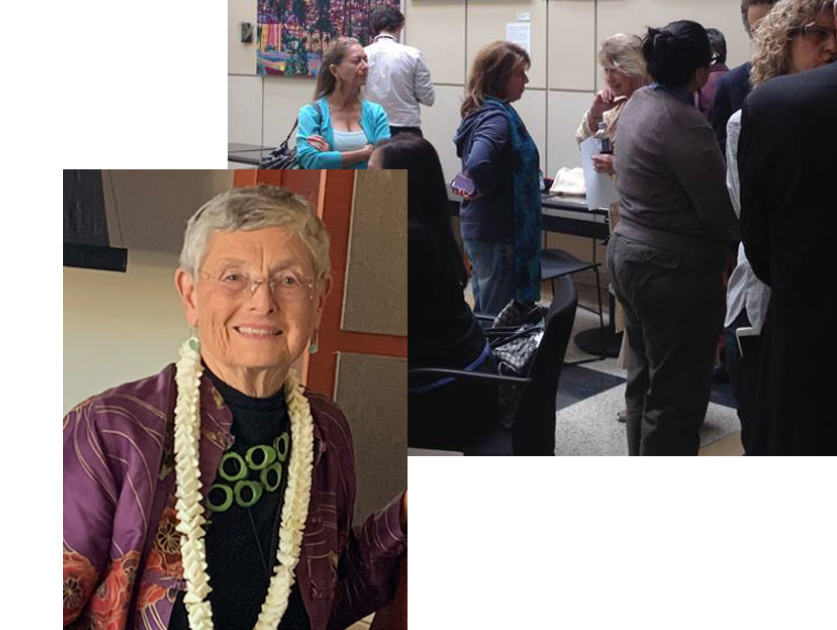 Lynn Crandall in an interview associated with the USC IGM Art Gallery. Source: Film/Video-Based Therapy, “USC Keck and Bravemind.”
Physicians of the Spirit
Physicians of the Spirit adds another useful record of the gallery’s history. I would describe it cautiously as an in-person gallery video or interdisciplinary conversation showing how medicine, values, presence, purpose, and inner life could be brought into public discussion. For me, it reinforces the idea that the gallery created room for serious reflection across disciplines without turning that public conversation into clinical care.
*Physicians of the Spirit — an in-person video associated with the USC IGM Art Gallery’s interdisciplinary history. Source: [YouTube video supplied for this article](https://www.youtube.com/watch?v=REn_A6F-VYk&t=27s).*Art, community, and social justice
The verified 2015 Keck recognition helps show what kind of space this was. The event included an exhibition by New Delhi artist Nikki Anand, and the source also identifies discussion leaders including Jim Beddows of PARC and Terance Wolfe of USC Marshall.
The combination of an international artist, community leaders, technology-oriented participants, and academic voices reflects the gallery’s wider purpose. Its programming created a meeting point among visual art, social engagement, business, education, and public dialogue.
In her foreword, former IGM Art Gallery Director Lynn Crandall describes this work as part of a larger commitment to educational and social reform, creative imagination, community capacity-building, interdisciplinary collaboration, and what she frames through both social and scientific epigenetics. She also places that work among the people, institutions, and surrounding contexts that shaped how the gallery functioned across USC and beyond it.
LaughMD and an in-person gallery event
A separate Keck article about a monthly stand-up comedy show at the Institute for Genetic Medicine Art Gallery and LaughMD at the USC IGM Art Gallery add another useful example. I include them here not to blur categories, but to show how open the gallery was to different forms of expression and shared presence. This documented in-person gallery performance and community event helps me remember that the gallery was not only about objects on walls. It was also about what could happen when people gathered, listened, responded, and participated together.
*LaughMD at the USC IGM Art Gallery — a documented in-person gallery performance/community event. Source: [YouTube video supplied for this article](https://www.youtube.com/watch?v=xz52L79thwE).*That matters when I think about the later virtual environment. Immersive storytelling did not appear from nowhere. It grew from an existing interest in connecting creative work with questions that extend beyond the gallery itself: Who gets to participate? How are stories represented? What kinds of institutions help communities communicate? What responsibilities accompany the use of new media?
The separate Bravemind context
The USC IGM Art Gallery and BRAVEMIND should not be treated as the same project.
BRAVEMIND is a separate clinical, interactive, VR-based exposure-therapy tool developed at the University of Southern California Institute for Creative Technologies. The source identifies Dr. Albert “Skip” Rizzo as the project principal investigator. The source describes BRAVEMIND as available free of charge for qualified clinical and research use when the requesting clinicians or researchers document relevant expertise in Prolonged Exposure Therapy for combat-related PTSD.
BRAVEMIND belongs to a clinical and research context. It is designed for use by qualified professionals, with equipment, clinical oversight, and research responsibilities separate from an art gallery or public storytelling environment.
I did not develop, operate, or clinically research BRAVEMIND. It matters here only as related USC context: an example of how immersive technology can be developed for a defined clinical and research purpose. It is not evidence that the USC IGM Art Gallery provided psychotherapy, and it does not turn the virtual gallery into a treatment setting.
From the physical gallery to an immersive environment
I understand the continuity from the physical USC IGM Art Gallery into virtual reality as a change in environment rather than a change in mission. Physical galleries offer architecture, walls, pathways, proximity, and shared presence. Immersive platforms can offer other forms of access: a sense of moving through a designed space, the ability to gather remotely, and a place where media and conversation can be arranged together.
The USC IGM Virtual Art Gallery presents that transition through FrameVR. I see it as an immersive art, storytelling, educational, and community environment where stories, artwork, and conversations meet.
The transition also connects with the recorded Educators in VR presentation “Virtual Reality and Emerging Technology”. Documentation around this work references Art Angels, Peer Mental Health, Painted Brain, Captain VR, Virtual Film School, Educators in VR, and AltSpaceVR as collaborators or broader contexts for the discussion.
The Decision Platform
I also see a related but separate example in The Decision Platform and The Decision Platform video. I am not presenting it as an extension of the gallery, an endorsement, or a current partnership. I mention it more narrowly as a commercial and organizational example involving data, emerging technology, human consultation, innovation, and decision-making. USC documents Jim Beddows as a discussion leader at the 2015 IGM gallery event; separately, the supplied Decision Platform video presents the platform’s data, machine-learning, and innovation-analysis work. For me, it belongs to the wider question of how people use tools and structured environments to think together, make sense of complexity, and act with more intention.
*The Decision Platform — a separate commercial/organizational example involving data, machine learning, and innovation analysis. Source: [The Decision Platform](https://www.decisionplatform.io/) and the direct video link [YouTube](https://www.youtube.com/watch?v=KzCt16PlTiA).*The continuity is therefore not simply a matter of putting photographs of a former physical exhibition online. It reflects a continuing question that still shapes my work: how can a shared environment be designed when people are participating through screens, headsets, avatars, recorded media, or other forms of digital access?
What the virtual gallery makes possible
A virtual gallery gives art, stories, and educational conversation a shared environment. That is both its possibility and its boundary.
The medium itself is not the therapist.
Virtual reality can shape representation, memory, interpretation, and communication. It can influence how someone encounters an image, follows a narrative, or understands a social space. But technology does not establish purpose by itself. The meaning of an immersive environment depends on design, consent, privacy, accessibility, audience, facilitation, and the responsibilities of the people involved.
This distinction matters even more when an environment includes themes related to trauma. A virtual gallery may provide room for witnessing, expression, learning, and discussion. It is not psychotherapy, treatment, or a source of post-traumatic growth.
We can make filmmaking more therapeutic without turning filmmaking into therapy. For me, that means asking better questions about what a medium can do, what it cannot do, and what kinds of human responsibility must remain in the foreground.
Where my work enters the story
My broader professional work brings together media psychology, filmmaking, digital storytelling, emerging technology, trauma scholarship, post-traumatic growth, and education. I am a media psychologist, clinically trained researcher, author/editor, educator, and storytelling/filmmaking coach. I developed the FILM/VIDEO-BASED THERAPY® framework.
As Lynn Crandall documents in her foreword, my work at the USC Institute for Genetic Medicine Art Gallery extended across departments on USC’s main and Health Sciences campuses. In her foreword, Crandall describes my work at the USC Institute for Genetic Medicine Art Gallery and across departments on USC’s main and Health Sciences campuses, connecting that experience to the broader development of my work in media psychology, digital storytelling, and immersive technology.
That history matters to me because media psychology asks how people encounter, interpret, create, and share mediated stories. It also asks what happens when storytelling technologies become more immersive, interactive, and socially consequential.
The 2026 Routledge volume Post-Traumatic Growth and Film/Video-Based Therapy: Cultivating Resilience Through Storytelling and Media Psychology, edited by Joshua L. Cohen, provides a scholarly context for examining relationships among storytelling, media, trauma, and post-traumatic growth. The Routledge record associates a foreword with Dr. Albert “Skip” Rizzo. In Rizzo’s foreword, he writes, “Both film and VR share the power and responsibility of being emotionally evocative technologies.” His broader discussion, as reflected in attributed paraphrase, emphasizes narrative experience, agency and ownership, storytelling as a way people process and reframe experience, the potential and limitations of emerging technology, and the importance of technology as a complement to rather than a replacement for human connection. None of that should be confused with evidence that the gallery or its VR environment is therapy.
What This History Does and Does Not Claim
The evolution from the USC IGM Art Gallery to an immersive virtual gallery shows how a creative environment can change while retaining a concern with art, community, education, and public dialogue.
It also demonstrates why technology should be discussed with precision. The virtual gallery can offer a shared place for encounter. BRAVEMIND can serve a separate clinical and research purpose. My scholarship and professional inquiry can examine how media, trauma, and storytelling relate. These are connected areas of interest, but they are not interchangeable services.
A model worth remembering
What stays with me most is that the gallery offered a model worth remembering. In my view, its enduring lesson is that art can convene medicine, education, business, media, spirituality, and community life while still respecting the boundaries among them. Innovation is not only about new devices or new platforms. It is also about creating places where people can see one another, think together, and decide what tools and stories are for.
Your story matters, too. That does not mean every story should be disclosed publicly, placed in VR, or shaped into a film. It means that representation requires consent, context, and respect for the person whose experience is being represented.
When I talk about VR Storytelling and Coaching, I mean responsible creative and educational work. I mean clarifying a project’s purpose, audience, authorship, agency, consent, accessibility, privacy, human relationships, and the limits of technology. I mean helping people think more carefully about what immersive storytelling is doing, what it is asking of participants, and what responsibilities come with that process.
For filmmakers and storytellers, the most valuable question may not be whether a new technology is powerful. It may be what the technology is asking the audience to notice, remember, feel, or reconsider: and whether the project’s creators have thought carefully about the consequences.
Bring your project. Ask better questions. Create with purpose.
References and source links
Watch and read
- USC Keck: White House Honors IGM Art Gallery Director Lynn Crandall
- Better Health Through Art: An Interview with Lynn Crandall
- USC IGM Art Gallery and Bravemind context
- Mental Health Storytelling Using Virtual Reality
- USC IGM Virtual Art Gallery in FrameVR
- Educators in VR: “Virtual Reality and Emerging Technology”
- Post-Traumatic Growth and Film/Video-Based Therapy: Cultivating Resilience Through Storytelling and Media Psychology
- Physicians of the Spirit
- The Decision Platform
- The Decision Platform video
- Institute for Genetic Medicine Art Gallery hosts monthly stand-up comedy show
- LaughMD at the USC IGM Art Gallery
This article is educational and historical/contextual. My current coaching, consulting, and educational services are nonclinical and do not constitute psychotherapy, psychological treatment, or a substitute for care from a licensed mental-health professional. The USC IGM Virtual Art Gallery is not presented as psychotherapy. BRAVEMIND is a separate USC ICT clinical/research tool. No clinical or mental-health outcome is promised.