My Story: I Didn't Erase My History. I Changed What I Made It Mean.
Dr. Joshua L. Cohen, Ph.D. — Media Psychologist, Author/Editor, Researcher, Educator & Storytelling/Filmmaking Coach
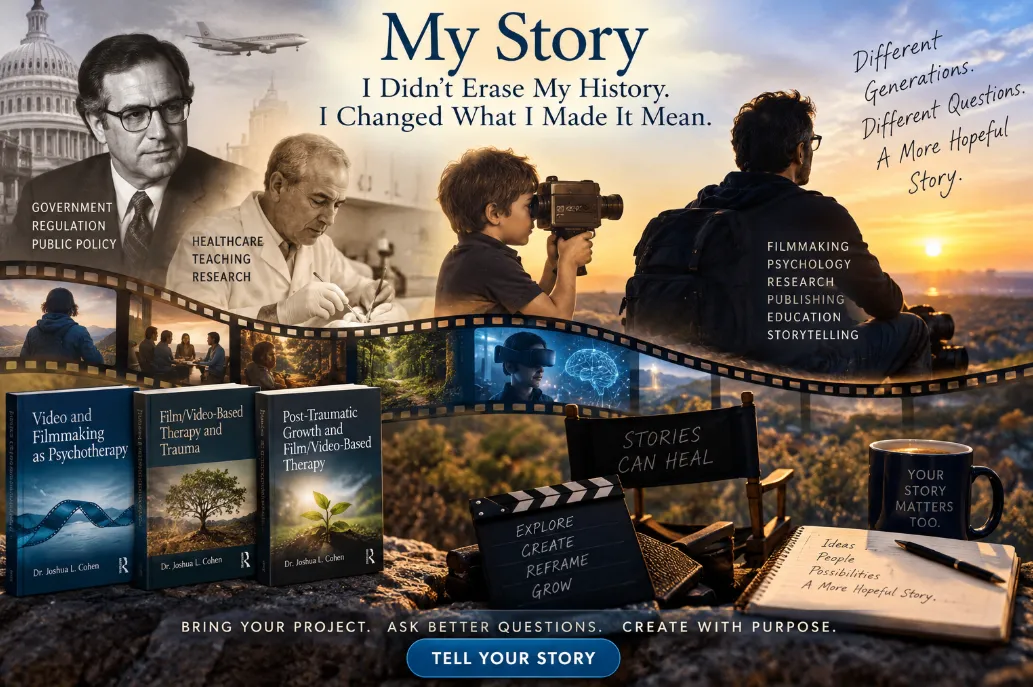
My story begins with family history, but it does not end there. I understand family history as context: not inherited authority, destiny, or proof of causality. Each generation encounters an existing story and decides what to do with it.
For readers interested in developing their own meaningful stories, Tell Your Story offers an author-led educational and coaching community focused on developing, revising, and sharing stories with greater intention.
Family history: government, healthcare, and the stories we inherit
Marvin S. Cohen was my paternal uncle. In 1978, he was confirmed as a member of the Civil Aeronautics Board (American Presidency Project, 1978; Congressional Record, 1978). Later that year, President Jimmy Carter named him chairman of the CAB, succeeding economist Alfred E. Kahn, as the agency entered the implementation period following enactment of airline deregulation legislation (American Presidency Project, 1978; Congressional Record, 1978; Shifrin, 1978). His public life belonged to the worlds of government, law, regulation, and public policy.
Archival video related to Marvin S. Cohen, former chairman of the Civil Aeronautics Board and my paternal uncle. The video is included as part of the family history discussed in My Story; historical claims concerning his CAB service are independently documented in the accompanying sources.
My father, Dr. Joseph R. Cohen, developed his career in dentistry and orofacial pain, combining clinical practice with academic teaching, professional leadership, research, and scholarly publication (Western Regional Dental Experience, 2026).
A PHOENIX magazine “Top Dentist” profile adds further detail: a 1969 graduate of the University of Tennessee dental school who was then in his 45th year of practice, he limited his practice to orofacial pain and was invited to be a professor in the first two-year residency in TMD and orofacial pain at UCLA, which began in 1990. He has served on the faculty of two CODA-accredited orofacial pain programs and as a site visitor for the American Dental Association. Asked what he would be if he were not a dentist, he answered, “A philosopher” (PHOENIX magazine, 2014).
My own work has developed in a different but related set of fields: filmmaking, psychology, research, publishing, education, and storytelling.
Marvin → Joseph → Joshua is not a ladder of inherited authority. It is a sequence of lives shaped by different questions. My uncle worked within public systems. My father worked within healthcare and professional scholarship. I became interested in how people understand themselves through images, stories, institutions, and technology.
The connection is not that one person caused the next person’s work. The connection is that every family leaves behind language, expectations, questions, and unfinished meanings. Each generation encounters an existing story and decides what to do with it.
Family-history sources
Congressional Record. (1978). Congressional Record: Proceedings and debates of the 95th Congress, second session (pt. 26). GovInfo. https://www.govinfo.gov/content/pkg/GPO-CRECB-1978-pt26/pdf/GPO-CRECB-1978-pt26-3-3.pdf
Shifrin, C. (1978, October 25). Cohen named CAB head to succeed Alfred Kahn. The Washington Post. https://www.washingtonpost.com/archive/business/1978/10/26/cohen-named-cab-head-to-succeed-alfred-kahn/2a04b734-8c4b-4215-a564-dd0cf85b3374/
American Presidency Project. (1978). Civil Aeronautics Board: Nomination of Marvin S. Cohen to be a member (September 15, 1978) and Letter on the resignation of Alfred E. Kahn as chairman (October 25, 1978). UC Santa Barbara. https://www.presidency.ucsb.edu/documents/civil-aeronautics-board-nomination-marvin-s-cohen-be-member and https://www.presidency.ucsb.edu/documents/civil-aeronautics-board-letter-the-resignation-alfred-e-kahn-chairman
Video note: "Marvin S. Cohen — Family and Historical Archive (undated). Family archive. Supplemental family/historical archival material; context and illustration, not independent proof of CAB facts."
Western Regional Dental Experience. (2026). Dr. Joseph R. Cohen [Speaker biography]. https://westernregional.org/2026/Attendees/Speaker_details.asp?SS=77u%2FMjUw&T=1&TITLE=Dr%2E+Joseph+R%2E+Cohen
PHOENIX magazine. (2014, August 1). 2014 Top Dentist: Dr. Joseph R. Cohen. https://www.phoenixmag.com/2014/08/01/dr-joseph-r-cohen/
These are the worlds my family inhabited. My own work — in filmmaking, media psychology, and storytelling — developed separately and is my own.
Filmmaking: learning to see, select, and interpret
I began making films when I was young. Later, I studied film and anthropology at Colorado College. Routledge’s biography records that I have worked in film and video production for more than 30 years and that I hold a bachelor’s degree in film and anthropology from Colorado College (Routledge, n.d.-a).
Filmmaking taught me that a story is not only made from what happens. It is also shaped by what we notice, what we leave out, where we place the camera, how we organize time, and how we edit one image against another.
Editing does not erase the footage that was recorded. The material may remain available, even when the sequence changes. What changes is the relationship among the images. A different order can produce a different question. A different point of view can reveal a different dimension of the same event.
I do not use this metaphor to suggest that every painful experience can be revised into something positive. Nor do I suggest that a new interpretation cancels what happened. I mean something more precise: facts may remain while their relationship and meaning can change.
That distinction became central to my understanding of identity. A person is not only a record of events. A person is also an interpreter, an editor, a participant, and sometimes an author of meaning.
Film and Soul
My 2013 dissertation, Film and Soul: A Theoretical Exploration of the Use of Video and Other Film-Based Therapy to Help Transform Identity in Therapeutic Practice, was an important stage in the development of my scholarly inquiry (Cohen, 2013).
The phrase “film and soul” points toward a question that has continued to guide my work: How can we attend to the inner significance of a person’s story without reducing that person to a category, diagnosis, biography, or collection of facts?
It means that images, editing, metaphor, voice, and collaboration can become ways of asking more exact questions about experience. The work begins when we notice that a story can be technically accurate and still fail to express what it means to the person who lived it.
The impact of technology on traumatic experiences
The impact of technology on traumatic experiences is one of the central concepts in my work.
Technology changes how experiences can be recorded, circulated, revisited, edited, and witnessed. A camera can preserve an image. A platform can distribute it. An editing system can place it beside another image. A virtual environment can alter the conditions under which an experience is represented. Artificial intelligence can introduce new questions about authorship, voice, consent, and control.
None of these technologies determines what an experience means. None is automatically therapeutic. The medium itself is not the therapist.
The important questions are relational and ethical:
- Who is making the image?
- Who has consented to its use?
- Who controls the material?
- What context surrounds it?
- What might the image reveal, conceal, intensify, or distort?
- How does the process affect the person represented?
- What responsibilities accompany the act of telling?
These questions matter because technology can change the distance between an experience and its representation. It can make memory more visible, but visibility is not the same as understanding. It can create connection, but connection is not guaranteed. It can give a person new creative choices, but choices must still be made within relationships, histories, and systems of power.
FILM/VIDEO-BASED THERAPY™
Over time, I developed FILM/VIDEO-BASED THERAPY™ as my named framework and body of scholarly work. I present it as one contribution to a broader field that includes therapeutic filmmaking, digital storytelling, media psychology, expressive arts, and related practices.
I do not claim to have invented every historical use of film, video, or media in therapeutic contexts. My contribution is the development, naming, writing, editing, and teaching of a framework that examines how filmmaking and video-based practices may be understood in relation to psychology, trauma theory, technology, ethics, and human meaning.
The distinction matters. Filmmaking is not therapy by itself. A camera is not a therapist. A finished film is not proof of psychological change.
At the same time, filmmaking can raise questions that ordinary conversation may not raise. It can make us examine point of view, sequence, silence, metaphor, audience, and representation. When this work takes place in a professional setting, safety, consent, relationship, context, and qualified practice remain essential.
We can make filmmaking more therapeutic without turning filmmaking into therapy.
The three Routledge books
My books represent a scholarly progression rather than a collection of credentials.
The first was Video and Filmmaking as Psychotherapy: Research and Practice, edited by Joshua L. Cohen, J. Lauren Johnson, and Penny Orr. Routledge identifies the first edition as copyright 2015, while the linked ISBN 9781138286962 record lists November 18, 2016 (Routledge, n.d.-a). The volume brought together research and practice concerning filmmaking, digital storytelling, psychology, ethics, and therapeutic contexts.
The Routledge table of contents lists Benjamin Patton as a co-author, with Rivka Tuval-Mashiach, of the chapter “Digital Video Production: Healing for the YouTube Generation of Veterans” (Routledge, n.d.-a). That reference is limited to the chapter’s authorship; it does not imply a broader collaboration, endorsement, or veterans-service role.
The second book was FILM/VIDEO-BASED THERAPY™ and Trauma: Research and Practice, edited by Joshua L. Cohen. The book carries a 2023 copyright, while Routledge’s publication record is dated December 30, 2022 (Routledge, n.d.-b). It extends the inquiry toward trauma, media, virtual reality, digital storytelling, expressive practices, and the ethical responsibilities involved in representing difficult human experiences.
The third book is Post-Traumatic Growth and FILM/VIDEO-BASED THERAPY™: Cultivating Resilience Through Storytelling and Media Psychology, edited by Joshua L. Cohen and published by Routledge on January 21, 2026 (Routledge, n.d.-c).
Its title identifies a field of scholarship. It does not promise that every person will experience growth, resilience, recovery, or a particular outcome. The book continues an interdisciplinary conversation about trauma, storytelling, media psychology, expressive practices, emerging technology, and the ways people and communities interpret difficult experiences.
Together, these books trace a movement from filmmaking and psychological practice toward a broader inquiry into trauma, technology, ethics, and post-traumatic growth scholarship.
Meaning is not erasure
My central idea is simple:
I didn’t erase my history. I changed what I made it mean.
That sentence does not describe escape from the past. It does not claim that interpretation can undo events. It describes the difference between being defined by an inherited story and participating consciously in the meaning of that story.
The same distinction guides my work with filmmakers. A project may contain material that is technically complete but emotionally, ethically, or psychologically unresolved. The question is not always “What should you add?” Sometimes the more important questions are: What perspective is missing? What assumptions are shaping the edit? Who is being represented? Who is being asked to carry the meaning? What possibilities are present but not yet visible?
Tell Your Story
This is where Tell Your Story begins.
Tell Your Story is an author-led educational and coaching community for developing, revising, and sharing meaningful stories. It is distinct from my Academic Publishing & Research Storytelling service. The community is oriented toward the person and project in front of us: the filmmaker, writer, educator, advocate, or storyteller trying to understand what a story is asking of them.
The same commitment to storytelling with intellectual responsibility also informs my separate work with researchers and academic authors through Academic Publishing & Research Storytelling. Academic storytelling is not about inventing a better story for the research. It is about discovering and clearly communicating the story the research can legitimately tell.
A conversation about a project can help identify questions that are difficult to see from inside the project itself. It may involve creative choices, psychological questions, ethical concerns, point of view, audience, technology, or meaning.
I didn’t erase my history. I changed what I made it mean.
The history you carry does not need to be denied in order for you to examine its meaning.
Your story matters, too.
Bring your project. Ask better questions. Create with purpose.
Join Tell Your Story on Skool:
https://www.skool.com/post-traumatic-growth-and-fvbt-4234/about
References
Cohen, J. L. (2013). Film and soul: A theoretical exploration of the use of video and other film-based therapy to help transform identity in therapeutic practice. Dissertation Abstracts International: Section B: The Sciences and Engineering, 74(6-B(E)). https://psycnet.apa.org/record/2013-99240-042
Congressional Record. (1978). Congressional Record: Proceedings and debates of the 95th Congress, second session (pt. 26). GovInfo. https://www.govinfo.gov/content/pkg/GPO-CRECB-1978-pt26/pdf/GPO-CRECB-1978-pt26-3-3.pdf
Routledge. (n.d.-a). Video and Filmmaking as Psychotherapy: Research and Practice. https://www.routledge.com/Video-and-Filmmaking-as-Psychotherapy-Research-and-Practice/Cohen-Johnson-Orr/p/book/9781138286962
Routledge. (n.d.-b). FILM/VIDEO-BASED THERAPY™ and Trauma: Research and Practice. https://www.routledge.com/FilmVideo-Based-Therapy-and-Trauma-Research-and-Practice/Cohen/p/book/9781032405766
Routledge. (n.d.-c). Post-Traumatic Growth and FILM/VIDEO-BASED THERAPY™: Cultivating Resilience Through Storytelling and Media Psychology. https://www.routledge.com/Post-Traumatic-Growth-and-FilmVideo-Based-Therapy-Cultivating-Resilience-Through-Storytelling-and-Media-Psychology/Cohen/p/book/9781032505879
Shifrin, C. (1978, October 25). Cohen named CAB head to succeed Alfred Kahn. The Washington Post. https://www.washingtonpost.com/archive/business/1978/10/26/cohen-named-cab-head-to-succeed-alfred-kahn/2a04b734-8c4b-4215-a564-dd0cf85b3374/
Western Regional Dental Experience. (2026). Dr. Joseph R. Cohen [Speaker biography]. https://westernregional.org/2026/Attendees/Speaker_details.asp?SS=77u%2FMjUw&T=1&TITLE=Dr%2E+Joseph+R%2E+Cohen
PHOENIX magazine. (2014, August 1). 2014 Top Dentist: Dr. Joseph R. Cohen. https://www.phoenixmag.com/2014/08/01/dr-joseph-r-cohen/
Tell Your Story provides creative education and Jungian-informed storytelling/filmmaking coaching. It is not psychotherapy, psychological services, diagnosis, treatment, clinical supervision, crisis care, legal advice, or a substitute for qualified professional care, and it does not promise clinical or mental-health outcomes. Dr. Cohen is not a clinical psychologist and does not provide psychological services.